

During my work on DesignCar, a mobile game built by Territory Studio, I was involved in a transition from C4D to Blender. As part of those changes I created this alternate UV projection workflow for our car models.
In the handoff from Territory’s art supervisor to me, we realized that most of our team was using Blender, and that some parts of our workflow had been inherited from C4D. In most cases this was a negligible difference, but it had a massive impact on the style of UV unwrapping for our vehicle skins.
Many UV mapping systems work, but we needed a solution that would match the visual quality of C4D’s “Shrinkwrap” projection.
With a bit of investigation, contacting C4D tech support, and internal discussions, I was asked to come up with the replacement workflow.
After figuring out that shrinkwrap projection was a very direct reference to the real world vacuum forming fabrication method, I set about characterizing that process.
When a vacuum former moulds a sheet of polystyrene it goes through three stages:
- Flat sheet (similar to UV 0,0-1,1)
- Stretched over the form (a low detail approximation of the form below)
- Sucked in under the form (highly detailed, concave shape)
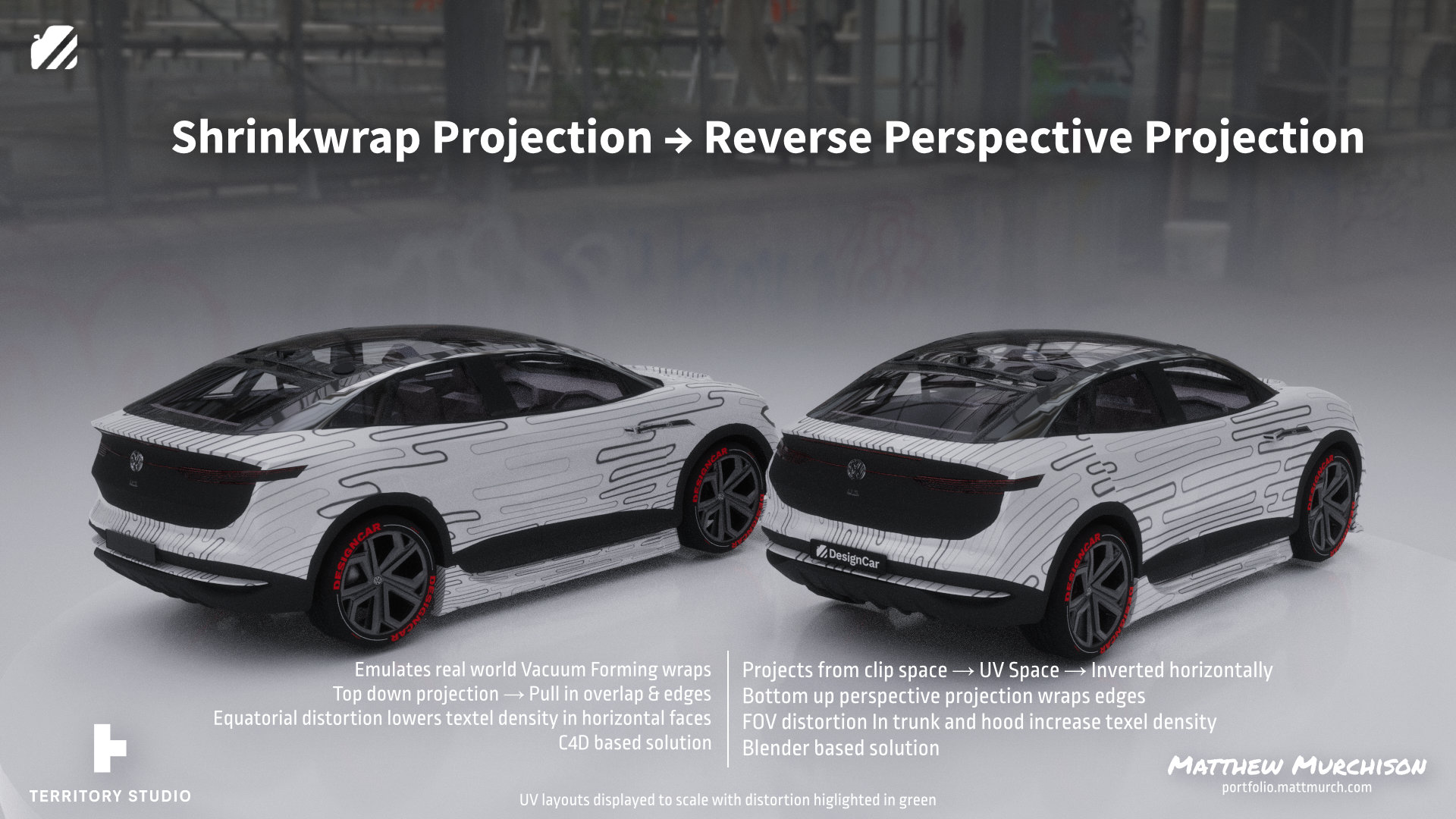
It’s pretty great logic to build a UV system around. It minimized distortion in step 2, and although step 3 introduces a lot of distortion, it’s all very evenly applied. As a UV projection you create consistent equatorial distortion, and on a car model that result looks pretty good.
A triplanar projection might offer more consistent texel density over the area of the mesh, but it would lose the consistent wrap style that players were familiar with.
Working backwards I realized that an upside down, extremely wide angle camera, located just below the car body, would deliver most of the visual fingerprints that the shrinkwrap created.

This perspective projection had similar roof results, identical door results, and more distorted but visually similar hood and trunk results. It’s not an identical projection, but it keeps the character of our UV wraps consistent on all cars.

Without the faith of Territory’s outgoing art Team Supervisor and Territory’s Producer, and our very patient QA contact, I probably wouldn’t have been given the opportunity to work out this system. I can’t thank them enough for their trust, and I’m very happy to say we used this projection on dozens of cars that made it into the live game without issue.


